728

Web Search


Sep 16, 2016

The Value of DNA Evidence

DNA is a powerful investigative tool because, with the exception of identical twins, no two people have the same DNA. In other words, the sequence or order of the DNA building blocks is different in particular regions of the cell, making each person's DNA unique. Therefore, DNA evidence collected from a crime scene can link a suspect to a crime or eliminate one from suspicion in the same way that fingerprints are used. DNA also can identify a victim through the DNA of relatives if a victim's body cannot be found. For example, if technicians have a biological sample from the victim, such as a bloodstain left at a crime scene, the DNA taken from that evidence can be compared with DNA from the victim's biological relatives to determine if the bloodstain belongs to the victim. When a DNA profile developed from evidence at one crime scene is compared with a DNA profile developed from evidence found at another crime scene, they can be linked to each other or to the same perpetrator, whether the crime was committed locally or in another state.

DNA evidence in the form of saliva, blood, skin tissue, hair, and semen are often recovered from crime scenes and can be crucial to the investigation of sexual assaults and other violent crimes. For example, during a sexual assault, biological evidence such as hair, skin tissue, semen, blood, or saliva can be left on the victim's body or at the crime scene. In addition, hair and fiber from clothing, carpet, bedding, or furniture could be transferred to the victim's body during an assault. This evidence is helpful in proving that there was physical contact between an assailant and a victim. DNA properly collected from the victim, crime scene, or suspect can be compared with known samples to place the suspect at the scene of the crime. If there is no suspect, however, a DNA profile of the crime scene can be entered into the Federal Bureau of Investigation's (FBI) Combined DNA Index System (CODIS), which allows agencies to match DNA profiles with other profiles entered into local, state, and national databases to identify a suspect or link serial crimes.

As with fingerprints, the effective use of DNA as evidence may require the collection and analysis of elimination samples to determine whether biological evidence came from a suspect or someone else. When investigating sexual assault or rape cases, it may be necessary to obtain an elimination sample, such as a blood or saliva sample, from the victim's relatives or consensual sex partner to account for all of the DNA found on the victim or at the crime scene.


Case Studies: The Power of a DNA Match

Nothing illustrates the power of DNA evidence more effectively than the case studies–or real–life experiences-of those whose lives have been changed by such evidence. Whereas some case studies demonstrate DNA's ability to exonerate inmates wrongfully convicted of crimes, others show the powerful sense of closure and relief that a DNA match can bring to victims of violent crime. The three very different case studies presented below reflect the power of a DNA match and reveal some of the complexities involved in the criminal justice system. Given the pain suffered and the time irrevocably lost, these individuals' stories also indicate an urgent need to improve the capabilities and response times of DNA databases and eliminate the growing backlog of rape kits.

A Lifetime Struggle: The Courage of Kellie Greene

Kellie Greene's life changed forever late one January evening more than 7 years ago following a visit to the laundry room in her apartment complex. As she opened the door to her apartment, she was brutally attacked by an intruder who smashed a tea kettle over her head and then raped her. At some point during the vicious attack, which lasted 45 minutes, Kellie's rapist used dishwashing detergent. It is unknown whether the rapist used it as a lubricant, after ejaculation to cleanse himself, or purposely to destroy crucial DNA evidence that ultimately could convict him of the assault. In any case, forensic experts with the Florida Department of Law Enforcement were able to retrieve a sample of the rapist's semen from the sweater Kellie wore that night. It was this key DNA evidence that, on February 28, 1997, linked David William Shaw to Kellie's attack on January 18, 1994. More than a month would pass, however, before she was told of the DNA match in April 1997.

The road to recovery for Kellie, and countless other rape survivors, is paved with anger, loss, rage, sadness, numbness, confusion, shame, guilt, fear, despair, and courage. The rape is a memory that never disappears and one that marks a woman's life forever. The experience shapes how she reacts to life's challenges and unexpected turns, how she gets through each day, how she sleeps at night, how she feels about her sexuality, how she feels about her body, and how she feels about men. "I think I always will struggle with the sexuality. It's never the same. Something that should be natural becomes something that you have to work at," Kellie said.

After Kellie's brutal attack and rape, she did not hesitate to report it to the authorities. "There wasn't any question. I was beat up really badly," she said. But once at the hospital, Kellie had to wait 3 hours in a hospital bed with her head wound still bleeding because the hospital would not treat her without first being seen by a medical examiner. It took seven staples to close the gash in her head.

At the time of her rape, Florida was not processing nonsuspect cases because of funding issues, and, as a result, DNA evidence in her case sat on a shelf for more than 3 years before it was analyzed. If it had not been for persistent law enforcement officers, particularly one detective, Kellie's rape kit might still be sitting on a shelf. Because officers thought Kellie's rape was similar to rapes occurring in Daytona Beach, less than 2 hours north of Orlando where Kellie's attack occurred, her rape kit was dusted off and examined. Once the results were entered into Florida's local DNA database, a hit was made via the FBI's CODIS system, allowing for an almost immediate match. Her rapist's DNA profile did not match the profile of the rapist in Daytona Beach but that of a man already serving a 25–year sentence for beating and raping a woman 6 weeks before attacking Kellie.

While Kellie's rapist remains behind bars today, she continues to fight to keep him there. Quirks in the criminal justice system, insensitivity toward the victim, and human error allowed her case to slip through the cracks more than once, resulting in a significantly reduced sentence for the offender. Not until late April 2000 was Kellie informed of a plea agreement stating that Shaw could serve concurrently a 22-year sentence for Kellie's rape, a 15-year sentence for a robbery, a 5-year sentence for obstructing justice, and the 25-year sentence for the first rape. A motion filed by the defense attorney to clarify the sentence never reached the state's attorney's office. Finally, the judge signed orders denying Kellie restitution and denying her request that Shaw be treated with chemical castration shots. As a result, Kellie's rapist could be released from jail as early as 2001. Had consecutive sentences been ordered for his brutal crimes, he would not be released until 2041.

After her trial, Kellie drafted and introduced a bill in the Florida legislature that would mandate consecutive sentences for convicted sex offenders and murderers in prison who are found guilty of subsequent offenses. Sponsored by Representative Randy Johnson (R), the legislation was called the Sexual Predator Prosecution Act of 2000. The bill passed Florida's House and Senate unanimously and was signed into law in June 2000.

Kellie has been speaking out about her rape and recovery for more than 6 years. In October 1999, she formed a nonprofit organization named SOAR-Speaking Out About Rape, Inc. She travels across the country giving rape awareness seminars about the healing process and the importance of DNA evidence in solving cases. SOAR gave her recovery a purpose. "I was able to learn something from it and to help others. So often people think of the rape only and not the aftereffects, she pointed out. "DNA is really an amazing tool. You don't know where you're going to get the DNA from but you can get it from a lot of places."

A First Step Toward Healing: Crime Victim Debbie Smith's Story
Everything changed for rape victim Debbie Smith when the man who had raped her 6 years earlier was identified. When processed through Virginia's DNA databank, the DNA sample of her assailant collected years earlier had produced a match or "hit" with DNA of an inmate in a Virginia prison. As reflected by her compelling testimony before the National Institute of Justice's National Commission on the Future of DNA Evidence, that DNA match gave Debbie final proof that her assailant would not "come back" for her, as he had threatened. What is more important is that it allowed her to begin healing.
Debbie's ordeal began at about 1 p.m. on May 3, 1989, at her home in Williamsburg, Virginia. She was cleaning house, doing laundry, and baking a cake. A light rain was falling, and her husband–a police lieutenant–was upstairs sleeping after working the night shift and appearing in court that morning. After stepping outside briefly, Debbie came back in and, for some reason, left the door unlocked. Within a few minutes, a masked stranger entered Debbie's house and nearly destroyed her life. The stranger dragged Debbie to a wooded area. He blindfolded her. He robbed her. And he raped her repeatedly, telling her, "Remember, I know where you live and I will come back if you tell anyone."

When allowed to return home, Debbie told her husband about the attack but in fear begged him not to call the police. She just wanted to take a shower and wash away the pain. Debbie's husband, however, convinced her to notify the police and visit a hospital where trained medical personnel could examine her and collect physical evidence that might identify the rapist. If she showered, that evidence would be lost. Debbie thanks God every day for her husband's advice. Although she was "plucked and scraped and swabbed" during her visit to the hospital, Debbie's rape examination kit produced the crucial DNA 
evidence that ultimately identified her attacker.

True peace of mind came for Debbie Smith on July 26, 1995, when a forensic scientist for the Commonwealth of Virginia notified Debbie that a DNA match had been made. Her assailant was serving time in a Virginia prison for a separate offense. For the first time since the rape, Debbie knew that her attacker could not come after her. Debbie learned later that her assailant had gone to jail only months after raping her. Because of a backlog in Virginia's DNA database, she waited 6 years to hear about it.

Proof of Innocence: Inmate Ronald Cotton's Story

Ronald Cotton's story begins on a summer night in 1984 when two rapes were committed in Burlington, North Carolina. In each case, an assailant entered an apartment, cut the phone wires, raped a woman at knifepoint, and stole money and other items. Both victims were taken to the hospital, where full rape examination kits were completed.

The first victim, 22-year-old Jennifer Thompson, described her attacker as a tall African-American man in his early 20s. Police collected photographs of area men meeting that description, including 22-year-old Ronald Cotton, a Burlington resident employed at a restaurant near Thompson's apartment. Cotton had two prior convictions: one for breaking and entering, and another for assault with intent to rape. Thompson selected Cotton from police photos as her rapist. When Cotton visited the police station to clear up the misunderstanding, he only strengthened the case mounting against him. He claimed that he had been with friends on the night of the rapes, but those friends did not corroborate his alibi. At a physical lineup of suspects, Thompson again selected Cotton. In August 1984, police arrested Cotton and took him into custody. In January 1985, Cotton was convicted of Thompson's rape and sentenced to life in prison. That verdict, however, was overturned, and a new trial was ordered. Cotton was optimistic given a crucial discovery he had made about one of his fellow inmates, Bobby Poole–a tall African–American young man from Burlington also convicted of rape who bore a strong resemblance to the composite sketch used in Cotton's case. Poole had reportedly bragged to inmates that he had committed the rapes for which Cotton was serving time.

The second trial was even more devastating than the first. Both victims testified against Cotton; the jury did not believe that Poole was the real assailant; and, most damaging of all, the court withheld evidence of Poole's alleged confessions. Convicted of both rapes, Cotton received two life sentences plus 55 years in prison.

Back in prison, Cotton "waited it out" for years. In 1994, however, he learned about DNA testing (a procedure unavailable at the time of his trials). He filed and won a motion for DNA testing. In 1995, Burlington police turned over to the court all case evidence containing semen or other bodily fluids. Samples from Jennifer Thompson had deteriorated and could not be tested, but those from the second victim provided a breakthrough for Cotton. On a tiny vaginal swab, scientists found a bit of sperm. Subjected to PCR testing, that sample showed no match to Ronald Cotton. He could not have committed the crime.
The state DNA database matched the sample to Bobby Poole. On June 30, 1995, almost 11 years after the rapes and 10 1/2 years after being taken into custody, Ronald Cotton was cleared of all charges and released from prison.


Sep 15, 2016

Microarray-based DNA decoding

A DNA microarray is a device for high-throughput investigations widely used in molecular biology and in medicine. It consists of an arrayed series of microscopic spots (‘features’ or ‘locations’) containing few picomoles of oligonucleotidescarrying a specific DNA sequence. This can be a short section of a gene or other DNA element that are used as probes tohybridize a DNA or RNA sample under suitable conditions. Probe-target hybridization is usually detected and quantified byfluorescence-based detection of fluorophore-labeled targets to determine relative abundance of the target nucleic acidsequences. Microarray has been used for the successfully decoding of ESAC DNA-encoded libraries. The codingoligonucleotides representing the individual chemical compounds in the library, are spotted and chemically linked onto themicroarray slides, using a BioChip Arrayer robot. Subsequently, the oligonucleotide tags of the binding compounds isolated from the selection are PCR amplified using a fluorescent primer and hybridized onto the DNA-microarray slide. Afterwards,microarrays are analyzed using a laser scan and spot intensities detected and quantified. The enrichment of the preferential binding compounds is revealed comparing the spots intensity of the DNA-microarray slide before and after selection.


Protocol for isolating High Molecular Weight DNA from mouse tails

(from Hogan et al., Manipulating the Mouse Embryo, Cold Spring Harbor, 1986, 1994)

Day 1
1. Cut 0.5 cm of tail and place in a 1.5 ml microfuge tube (tails can be frozen at -20°C prior to extraction). These tail biopsies will be performed by the Core.
2. Add 0.7 ml of 50 mM Tris (pH 8.0), 100 mM EDTA, 0.5% SDS to each tube. Add 35 ul of a fresh 10 mg/ml solution of Proteinase K dissolved in 50 mM Tris (pH 8.0), 1 mM CaCl2.
3. Incubate at 55°C overnight on a gently rocking platform.

Day 2

4. Remove tubes from 55°C. Add 0.7 ml phenol (equilibrated with Tris pH 8.0). Close tube and shake vigorously for 3 min, so that phases mix completely.
5. Centrifuge 3 min in a microfuge. Phases will separate.
6. Transfer upper aqueous phase to a fresh tube, being careful not to pick up phenol or material at the interface.
(note, We have had good results using Phase Lock Gel I tubes at this step (Catalog #p1-188233, from 5′-3′, Inc., but it is not required.)
7. Add 0.7 ml of phenol/chloroform (1:1), shake vigorously for 2 min, and centrifuge for 2 min.
8. Again remove aqueous phase, avoiding interface, and transfer to a fresh tube (1.5 ml).
9. Add 70 ul of 3 M sodium acetate, pH 6.0 (i.e. 1/10 volume), and 0.7 ml of 100% ethanol at room temperature. Shake to mix thoroughly. DNA should immediately form a stringy precipitate. Sodium acetate with a pH lower than 6.0 will cause the EDTA to precipitate and should not be used.
10. Spin in a microfuge for 30 seconds to pellet DNA. Remove and discard as much ethanol supernatant as possible.
11. Add 1 ml of 70% ethanol (room temperature) to tube, and vortex or shake vigorously to wash the DNA pellet. This step is essential to remove traces of SDS and phenol.
12. Microfuge for 1 min at room temperature. Remove as much ethanol as possible. Dry DNA briefly in vacuo.
13. Resuspend the DNA pellet in 0.1 ml 10 mM Tris, pH 8.0/1 mM EDTA. Leave at room temperature several hours or heat at 65°C for 5-10 min to dissolve completely. The DNA should have an A260/A280 of >1.7. The concentration should be calculated using 50 ug/ml = 1.0 A260. Use 10 ug of each DNA sample for Southern blot analysis.
14. DNA prepared in this manner will contain a substantial amount of RNA, but this will not interfere with restriction digestion or Southern blot analysis. 5 mg of DNAse-free RNaseA can be added to each sample during restriction digestion if you like.
15. Be sure to include appropriate positive and negative controls with your Southern analysis. A negative control should be normal mouse DNA, usually 1 ug for PCR or 10 ug for Southern blot. Positive controls should be addition of your transgene to normal mouse DNA, at one, five and ten single copy equivalents of the fragment. 


DNA, genes and chromosomes (2)


Alleles

There are pairs of chromosomes in the nucleus of a body cell. The chromosomes in a pair carry the same genes in the same places. But there are different versions of the same gene.
Different versions of the same gene are called alleles. For example, the gene for eye colour has an allele for blue eye colour and an allele for brown eye colour. For any gene, a person may have the same two alleles or two different ones.
A: Allele blue , allele brown heterozygous dominant, brown eyes. B: Two alleles brown, homozygous dominant, brown eyes.  Individual C: Two blue alleles, homozygous recessive, blue eyes.

Dominant or recessive alleles

Alleles may be either dominant or recessive:
  • dominant allele is always expressed, even if the individual only has one copy of it. For example, the allele for brown eyes is dominant. You only need one copy of it to have brown eyes. Two copies will still give you brown eyes.
  • recessive allele is only expressed if the individual has two copies of it and does not have the dominant allele of that gene. For example, the allele for blue eyes is recessive. You need two copies of this allele to have blue eyes.


Mitosis

In mammals, body cells are diploid. The chromosomes need to be copied exactly so that new cells can be produced for:
  • growth
  • repair to damaged tissue
  • replacement of worn-out cells
The type of cell division involved is called mitosis. The diagram shows how it works.
Mitosis. Chromosomes in nucleus are copied.  Chromatids pulled apart and moved towards poles. Chromosomes separate, cell divides

Identical cells

Mitosis produces two genetically identical cells in which the number of chromosomes is the same as in the original cell.

Meiosis

Meiosis is the type of cell division that produces gametes. A human body cell contains 46 chromosomes arranged in 23 pairs. Human gametes are haploid – so their nucleus only contains a single set of 23 unpaired chromosomes.
The diagram shows the stages of meiosis.
Meiosis. Parent cell. Chromosomes make identical copies of themselves. Similar chromosomes pair up. Sections of DNA get swapped. Pairs of chromosomes divide. Chromosomes divide.

Reduction division

Meiosis produces four genetically different haploid cells. Unlike mitosis, meiosis is a reduction division – the chromosome number is halved from diploid (46 chromosomes in 23 pairs in humans) to haploid (23 chromosomes in humans).
MitosisMeiosis
Number of cells produced24
Chromosome numberDiploidHaploid
Genetically identicalYesNo
Used forGrowth, repair, asexual reproductionProduction of gametes for sexual reproduction

DNA, genes and chromosomes

DNA
DNA molecules are large and complex. They carry the genetic code that determines the characteristics of a living organism.
Except for identical twins, each person’s DNA is unique. This is why people can be identified using DNA fingerprinting. DNA can be cut up and separated, forming a sort of 'bar code' that is different from one person to the next.

Genes

gene is a section of DNA that codes for a specific protein. It is the unit of heredity, and may be copied and passed on to the next generation.

Chromosomes

The cell’s nucleus contains chromosomes. These are long threads of DNA, each made up of many genes.
The diagram shows the relationship between the cell, its nucleus, chromosomes in the nucleus, and genes.
Nucleus, with a chromosome magnified showing the DNA of a gene.<


The structure of DNA

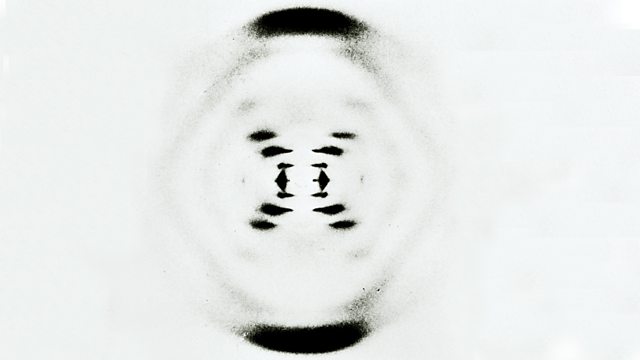
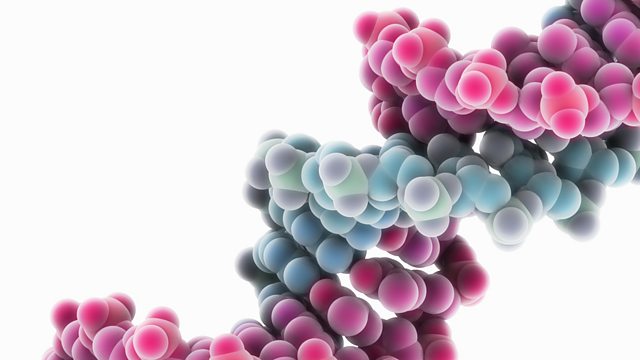
James Watson and Francis Crick worked out the structure of DNA in 1953. By using data from other scientists they were able to build a model of DNA. The X-ray data they used showed that DNA consists of two strands coiled into a double helix.
DNA diffraction
X-ray diffraction photograph of DNA
Synthetic DNA molecule

Base pairs

Each strand of DNA is made of chemicals called bases. Note that these are different to bases in relation to acids and alkalis in chemistry. There are four different bases in DNA:
  • thymine, T
  • adenine, A
  • guanine, G
  • cytosine, C
There are chemical cross-links between the two strands in DNA, formed by pairs of bases. They always pair up in a particular way, called complementary base pairing:
  • thymine pairs with adenine (T–A)
  • guanine pairs with cytosine (G–C)
DNA strand showing bases pairs: TA, GC, AT repeated randomly.
Base pairs on a section of DNA

>

DNA sequenced in space for first time

Nasa astronaut Kate Rubins carried out the test on the International Space Station (ISS) at the weekend.
She was using a compact DNA sequencing device called Minion, which was developed in the UK.
The device, which was sent up to the space station in July, could help astronauts diagnose illness in space and allow them to identify disease-causing microbes on the ISS.
DNA sequencing is the process used to determine the order of the four chemical building blocks that make up the genetic information from a given living organism.
While Dr Rubins carried out her work on the orbiting outpost, researchers were simultaneously sequencing identical test samples on the ground.
The experiment was set up to attempt to make spaceflight conditions, particularly microgravity, the only variables that could account for differences in the results.
Using the Minion in a weightless environment introduces several challenges including the formation of air bubbles in fluid used in the test.
Bubbles rise to the top of a liquid solution and can be removed by centrifuge. But in space, bubbles are less predictable.
Sarah Castro-Wallace, project manager for the experiment, said: "Onboard sequencing makes it possible for the crew to know what is in their environment at any time.
"That allows us on the ground to take appropriate action - do we need to clean this up right away, or will taking antibiotics help or not?
"We can resupply the station with disinfectants and antibiotics now, but once crews move beyond the station's low Earth orbit, we need to know when to save those precious resources and when to use them."